


Note: Unconstrained Kids unpacks, translates, and integrates academic research and data about skill type and the science of skill building to support the improvement of PK-12 reading, writing, and mathematics. Despite important differences, all reading, writing, and math skills can be boiled down to two types–constrained and unconstrained. This post provides an overview of both types of skills. Like everything on this Substack, this post is a work-in-progress. I will make updates as needed. Footnotes and citations are included at the end. Questions, comments, and suggestions are welcome.
First posted: March 7, 2025
Last updated: June 10, 2026
Three Big Ideas
Two types of skills support reading, writing, and math achievement —constrained and unconstrained skills.
These two skill types differ in the amount of information involved, access to this information, clarity of the definition of mastery, and the universality of measures of mastery.
Most typically developing children reach relatively high levels of proficiency in constrained skills. By contrast, more children achieve lower levels of proficiency in unconstrained skills.
Two types of skills support reading, writing, and math achievement
In 2005, Scott Paris, a former University of Michigan professor, published the first of a series of academic papers describing differences in relationships between various reading skills over time.1 He divided reading skills into two categories based largely upon features related to their mastery: constrained and unconstrained.
Over the next 20 years, other researchers built upon this Constrained Skill Theory. Initial contributors continued to focus on early literacy, adding implications for instruction and policy. Later researchers added math skills and executive function skills.
Today, researchers suggest skills differ in four fundamental ways:
The amount of information associated with learning a particular skill.
The definition of mastery of a skill and whether it’s the same for everyone.
The amount of time typically needed to reach mastery of a skill.
The manner in which a skill is learned or acquired.
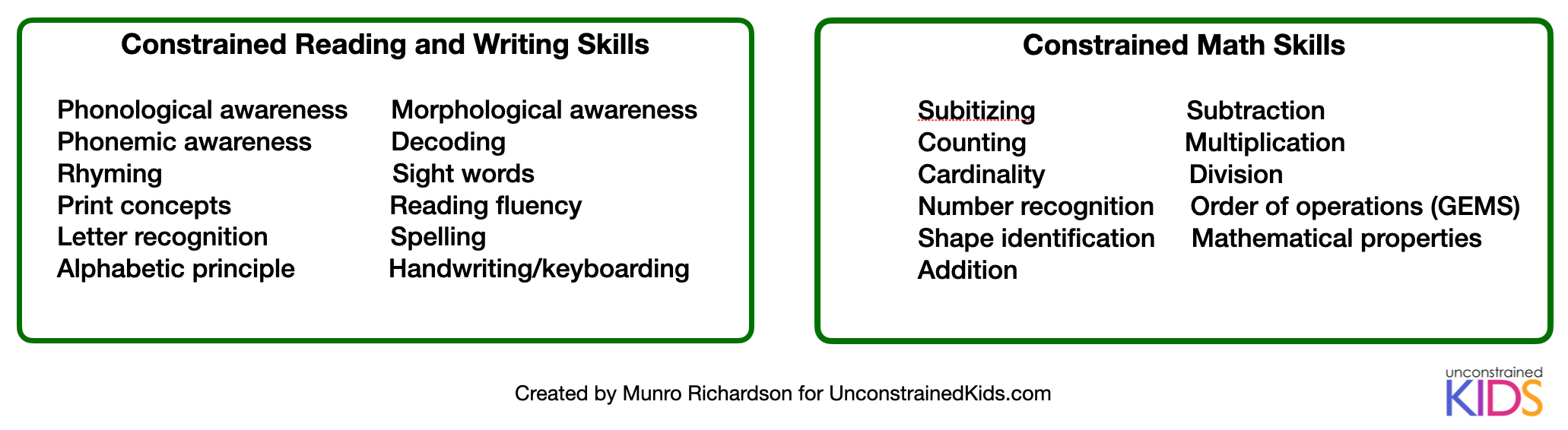
Constrained skills
Constrained skills involve a relatively limited amount of information.2 Everyone works with the same information.3 Mastery is clearly defined. The yardstick for mastery is the same for everyone.4 These constrained skills support reading, writing, and mathematics.
Data
I review student proficiency in reading and math skills using a nationally representative dataset of U.S. nine-year-olds: the National Assessment of Educational Progress Long-Term Trend Assessment (LTT).5 The NAEP LTT comes from the National Center for Education Statistics. This long-term trend version of the NAEP dates to the early 1970s. Performance levels in reading and math on the NAEP LTT can readily be ordered from more to less constrained. Roughly 7,400 nine-year-olds for each subject in each testing round. LTT is assessed for nine-year-olds during the school year from January through March.
Figure 1 shows the percentage of U.S. nine-year-olds across racial subgroups who were proficient in a constrained math skill: simple arithmetic.6 Between 2008 and 2020 virtually all American nine-year-olds were highly proficient in this constrained math skill.7 The closing of schools and community spaces due to the COVID-19 global pandemic caused a temporary widening of skill performance, but this gap narrowed in 2025.
Figure 1
Now, let’s turn to reading. Figure 2 shows the percent of U.S. nine-year-olds who were proficient in simple reading tasks.8 Proficiency is not as universally high as math skills. However, the gap between student racial groups was limited to 6 to 8 points prior to the pandemic. (Mouse over the chart to see the percentages.) And all student groups were generally 90% proficient or higher.9 Similar to math, the drop in skill performance in 2022 due to the global pandemic was effectively erased in 2025.
Figure 2
Unconstrained skills
Unconstrained skills involve much broader amounts of information. Everyone doesn’t have access to the same information. Unlike constrained skills, there is no universal finish line for mastery. There is always the opportunity to learn more.
I’ve identified four groups of unconstrained skills from a review of research on unconstrained skills, as well as reading, writing, and math cognition.
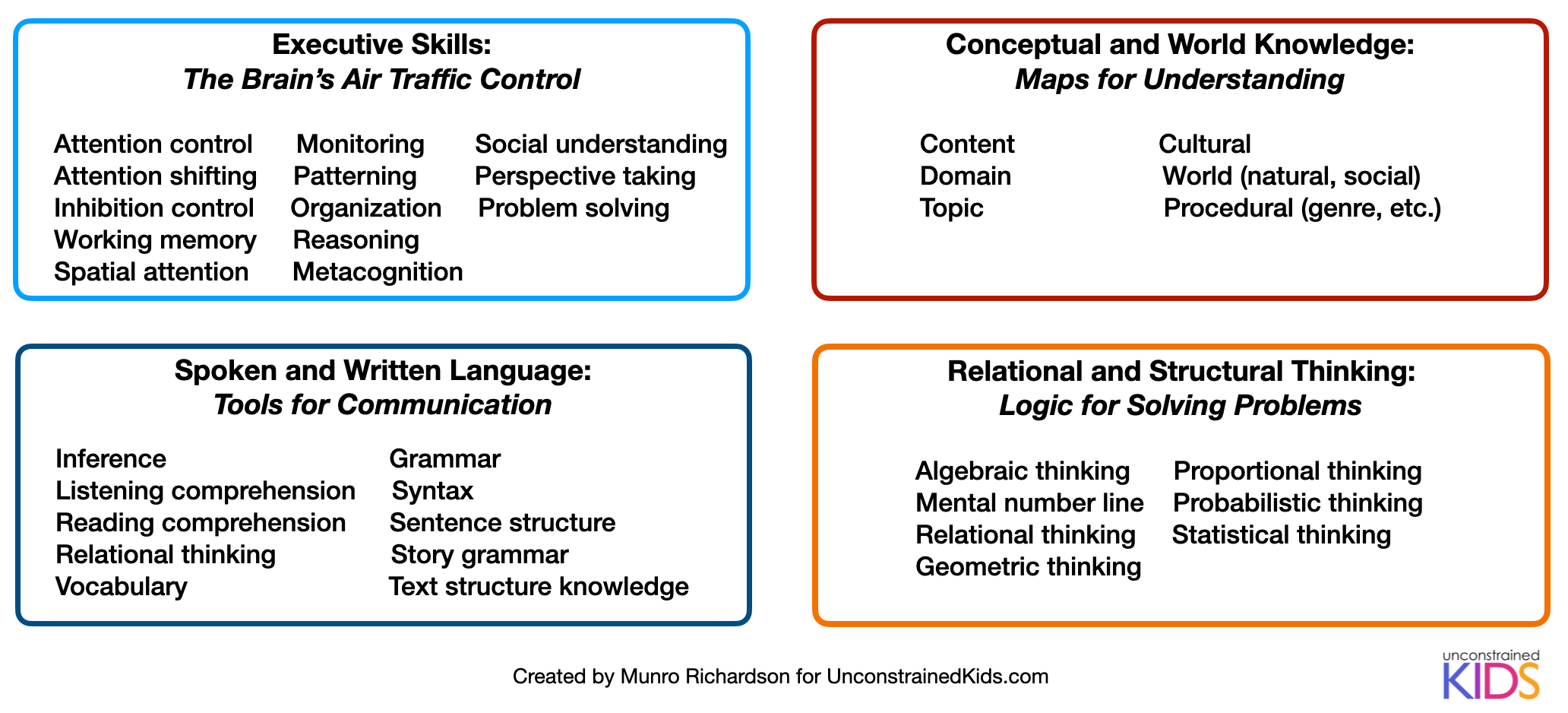
Figure 3 looks at math proficiency again on the NAEP LTT for U.S. nine-year-olds, this time for an unconstrained math skill: math operations and reasoning.10 Unlike the constrained math skill in Figure 1, we see significant and persistent gaps across student racial groups over nearly two decades.
Figure 3
Figure 4 shows the same information for an unconstrained reading skill: simple inferential comprehension.11 Once again, we see significant and persistent gaps in skills across student groups for nearly 20 years.
Figure 4
A continuum of constraint
So far, I’ve described skills as either “constrained” or “unconstrained.” In reality skills fall along a “continuum of constraint” (Paris, 2005; Stahl, 2011; McCormick & Mattera, 2022). Constrained skills sometimes are divided into “highly constrained” and “moderately constrained.” But unconstrained skills have degrees of constraint, too. For example, comprehension is an unconstrained skill. Yet, literal comprehension (without inference) of simple text is more constrained than inferential comprehension of complex text.
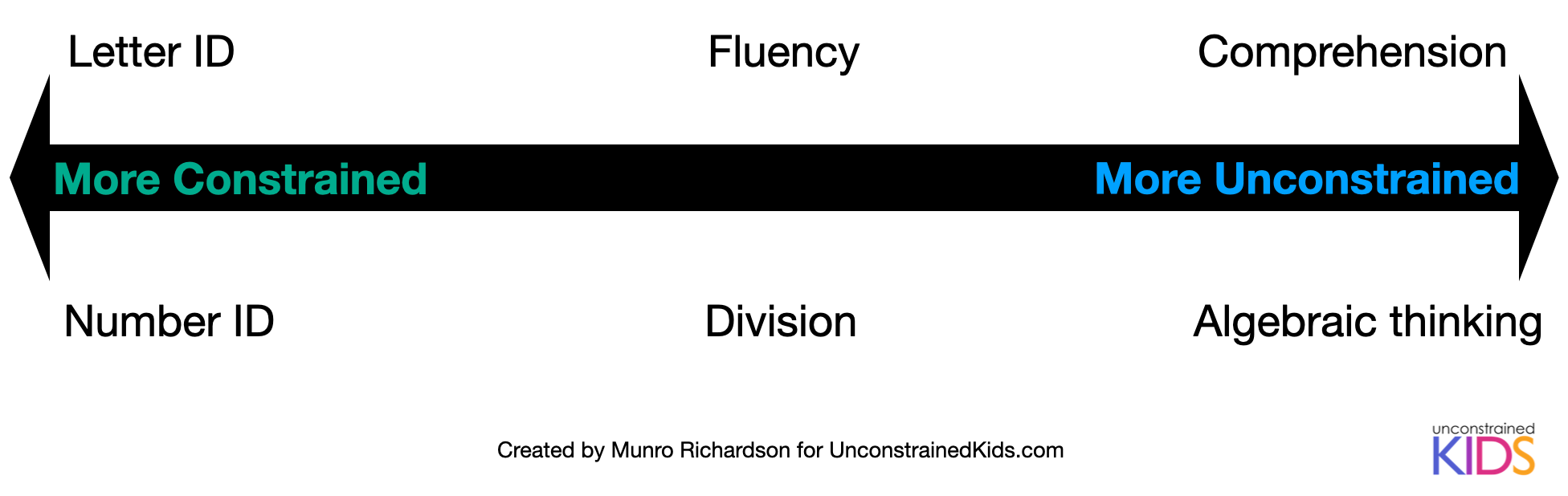
As skills become less constrained, they require the acquisition, consolidation, integration, and generalization of more information. This “information” sometimes takes the form of proficiency in earlier component skills. For example, proficiency in letter identification becomes integrated into word reading, just as number identification is absorbed into skill in addition.
Not another way to say “simple” versus “complex”
One might be tempted to think that constrained and unconstrained skills is an overly complicated way of describing “simple” versus “complex” skills. To some degree, this is true for some skills. For example, letter knowledge (constrained) is clearly much simpler than reading comprehension (unconstrained).
Many unconstrained skills, however, defy this simple categorization. For example, unconstrained skills such as vocabulary and background knowledge — critical for reading and math — can’t be categorized as merely more “complex” than constrained skills such as reading fluency or addition. Executive function skills such as working memory, impulse control, or attention shifting don’t fit into the “simple versus complex” classification.
So far, we’ve addressed the first two of four defining characteristics of constrained and unconstrained skills at the beginning of this post. A review of the other two features — the time needed for mastery and the manner in which skills are developed — offers a greater appreciation of the importance of skill type for reading, writing, and math achievement. This is the topic of the next post in this series.
But wait, there’s more
If you’d like to learn more about constrained and unconstrained skills, check out these other posts:
Works cited
McCormick, M., & Mattera, S. (2022). Learning more by measuring more: Building better evidence on pre-k programs by assessing the full range of children’s skills. MDRC.
Paris, S. G. (2005). Reinterpreting the development of reading skills. Reading Research Quarterly, 40(2), 184-202.
Stahl, K. A. D., & García, G. E. (2022). Expanding reading comprehension in grades 3–6: Effective instruction for all students. New York: The Guilford Press.
Although I describe constrained and unconstrained as two categories, in reality they exist along a continuum. Some constrained skills (e.g. letter knowledge) are more constrained than other constrained skills (e.g. reading fluency). The same is true for unconstrained skills; some are less constrained than others.
For example, English speakers all work with the same 26 letters of the alphabet and 44 sounds (phonemes).
For English speakers, you either know all 26 letters of the alphabet or not. You know all 44 phonemes or you do not. You know all the letter-sound combinations (roughly 240) or you do not. Proficiency is evaluated the same way for everyone.
Performance levels on the NAEP LTT can readily be ordered from more to less constrained. By contrast, achievement levels on the main NAEP are not as amenable. Despite the name (“long-term trend”) the NAEP LTT assesses different groups of kids at a single point in time (a cross-section). Thus, we are not able to track children’s progress over time. Nonetheless, we can use the LTT to compare more patterns of skill development of nationally representative cohorts of U.S. 9-year-olds over time.
From the NAEP website: “Students at this level know some basic addition and subtraction facts, and most can add two-digit numbers without regrouping. They recognize simple situations in which addition and subtraction apply. They also are developing rudimentary classification skills.”
We can see the effect of the pandemic in 2022. I don’t cover this topic in this post. My review of NAEP long-term trend data between 2020 (pre-pandemic) and 2022 shows that the overall drop in reading and math scores was heavily driven by declines in unconstrained skills.
From the NAEP website: “Readers at this level can follow brief written directions. They can also select words, phrases, or sentences to describe a simple picture and can interpret simple written clues to identify a common object. Performance at this level suggests the ability to carry out simple, discrete reading tasks.”
Recent efforts focused on the ‘science of reading’ promise to close this gap even further in the years ahead.
From the NAEP website: “Students at this level have an initial understanding of the four basic operations. They are able to apply whole number addition and subtraction skills to one-step word problems and money situations. In multiplication, they can find the product of a two-digit and a one-digit number. They can also compare information from graphs and charts, and are developing an ability to analyze simple logical relations.”
From the NAEP website: “Readers at this level can locate and identify facts from simple informational paragraphs, stories, and news articles. In addition, they can combine ideas and make inferences based on short, uncomplicated passages. Performance at this level suggests the ability to understand specific or sequentially related information.”