


Note: Unconstrained Kids unpacks, translates, and integrates academic research and data about skill type and the principles of skill building to support the improvement of PK-12 reading, writing, and mathematics. This post is part of a series that describes 7 key principles of skill building I identified from Dynamic Skill Theory and the Science of Learning and Development. Like everything on this Substack, this post is a work-in-progress. I will make updates as needed. Citations are included at the end. Questions, comments, and suggestions are welcome.
First posted: June 4, 2025
Last updated: July 24, 2026
Key Takeaway
Skill is the capacity to think and act in an organized way in a specific context (Immordino-Yang and Fischer, 2010). The developmental range is the difference in a person’s skill level with social support (optimal level) and without support (independent level). It is the elastic ability to use a wider range of skill that ultimately distinguishes children and youth with highly proficient skills. With the right amount of challenge, rigor, feedback, and support, we can intentionally help children expand their developmental range (Cantor et al., 2019).
As we saw in Principle 1, skill is the capacity to think and act in an organized way in a specific context (Immordino-Yang and Fischer, 2010). Context involves many factors at once, such as the environment, emotional state, and activity. One of the key features of context is the degree of support to engage in an activity. We routinely demonstrate different levels of ability depending upon the support we receive. For example, consider the difference in ability in cooking an unfamiliar dish. Our skill is drastically different with a well-written recipe or video on YouTube than fumbling around on our own.
This difference between a person’s ability with and without support is known as the developmental range (Fischer & Bidell, 2006). This is the space between the dotted blue line (independent skill level) and the solid red line (optimal skill level) in this graphic.
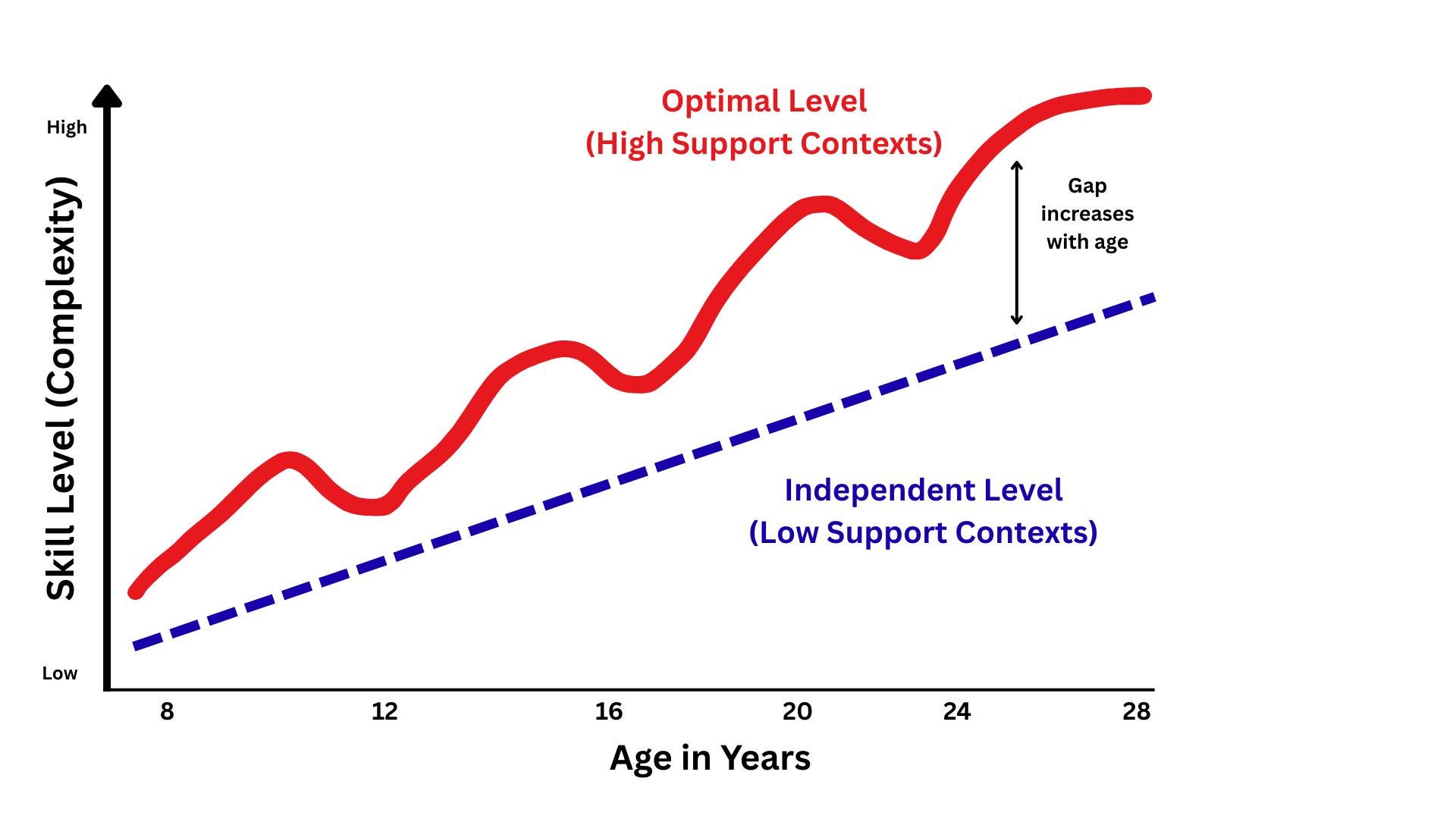
Everything up to the blue line represents skills the person can already perform effortlessly on their own. The range between the blue and red lines highlights the power of environmental support to stretch performance to its upper limit. This is one of the most important ideas in skill building. Our skill level constantly moves across this range.
“Skills are not all or none: A person does not suddenly move from not being able to perform a task to performing it well. Instead, a person’s skills vary frequently between two upper limits – a functional level, the most complex performance that a child or adult performs without support, and an optimal level, the most complex performance that she or he performs with explicit support, such as through modeling or priming.” (Fischer and Immordino-Yang, 2002)
Educators will recognize shades of Lev Vygotsky’s classic Zone of Proximal Development (ZPD) here, but there is an important difference. The ZPD focuses primarily on the potential for growth–the “sweet spot” for instruction that exists at the space a learner cannot do alone but can master with help from a more knowledgeable person. The developmental range, however, focuses on the variability of performance across different contexts. A person’s skill level isn’t a fixed point but a range that fluctuates based on support and familiarity.
Elevating the developmental range
When children and youth have the opportunity to build and practice skills in conditions of high support—emotional engagement, structured activities, familiar tasks, high motivation, co-development of skills with others—their ability is closer to the red line. They are able to experience a level of skill complexity that they could not accomplish on their own. In the right circumstances, well-designed instructional materials and resources can provide this type of external support.
When this support is removed, however, their skill level falls down towards the blue line. Repeated exposure to this type of experience over time raises their independent skill levels. In other words, lots of experience closer to the red line helps pull up the skill level of the blue line.
When children take standardized tests, we are measuring their ability at their independent level–the blue line. In conditions of stress or gripped with negative emotions, it’s possible to perform below this level. Not every task or everyday problem requires the absolute ceiling of our capabilities. Yet, it is the elastic ability to use a wider range of skill that ultimately distinguishes children and youth who have higher levels of reading and mathematics achievement from their peers. In other words, their abilities are woven together tightly—giving them thicker, more resilient “skill ropes” that don’t easily snap under pressure (Fischer et al., 1993; Fischer, 2008; Mascolo & Fischer, 2010; Cantor et al., 2019).
Elevating this developmental range—and accelerating a youth's growth within it—is one of the most critical responsibilities shared by schools, out-of-school programs, and families alike. Children need opportunities to build, practice, and refine skills in a variety of contexts to build durable, flexible skills. By engineering the right mixture of challenge, rigor, feedback, and support, we can help children develop these skills to meet a wide range of demands in a rapidly changing world (Cantor et al., 2019).
But wait, there’s more
Works Cited
Cantor, P., Osher, D., Berg, J., Steyer, L., & Rose, T. (2019). Malleability, plasticity, and individuality: How children learn and develop in context. Applied Developmental Science, 23(4), 307–337.
Fischer, K. W. (2008). Dynamic cycles of cognitive and brain development: Measuring growth in mind, brain, and education. In A. M. Battro, K. W. Fischer, & P. Léna (Eds.), The educated brain (pp. 127–150). Cambridge University Press.
Fischer, K. W., & Bidell, T. R. (2006). Dynamic development of action and thought. In R. M. Lerner & W. Damon (Eds.), Handbook of child psychology: Theoretical models of human development (6th ed., pp. 313–399). John Wiley & Sons, Inc.
Fischer, K. W., Bullock, D. H., Rotenberg, E. J., & Raya, P. (1993). The dynamics of competence: How context contributes directly to skill. In R. Wozniak & K. Fischer (Eds.), Development in context: Acting and thinking in specific environments. Lawrence Erlbaum Associates.
Fischer, K. W., & Immordino-Yang, M. H. (2002). Cognitive development and education: From dynamic general structure to specific learning and teaching. In E. Lagemann (Ed.), Traditions of scholarship in education. Spencer Foundation.
Immordino-Yang, M. H., & Fischer, K. W. (2010). Neuroscience bases of learning. In V. G. Aukrust (Ed.), International encyclopedia of education (3rd Edition, pp. 310–316). Elsevier.
Mascolo, M. F., & Fischer, K. W. (2010). The dynamic development of thinking, feeling, and acting over the lifespan. In R. M. Lerner (Ed.), Handbook of life-span development (Vol. 1, pp. 149–194). Wiley.