


Note: Unconstrained Kids unpacks, translates, and integrates academic research and data about skill type and the science of skill building to support the improvement of PK-12 reading, writing, and mathematics. Despite important differences, all reading, writing, and math skills can be boiled down to two types–constrained and unconstrained. This post is the second in a series that provides an overview of both types of skills. Like everything on this Substack, this post is a work-in-progress. I will make updates as needed. Footnotes and citations are included at the end. Questions, comments, and suggestions are welcome.
First posted: March 7, 2025
Last updated: April 18, 2026
Three Big Ideas
Two types of skills support reading, writing, and math achievement—constrained and unconstrained skills.
Most children reach relatively high levels of proficiency in constrained skills in elementary and middle school. By contrast, significant gaps in proficiency in unconstrained skills persist across socioeconomic groups.
Constrained and unconstrained skills follow distinct developmental pathways. Constrained skills are largely developed in formal classroom settings. Unconstrained skills are developed both inside and outside of classrooms.
Two types of skills; two developmental pathways
In a previous post, we introduced the idea that there are two types of skills that support reading, writing, and math achievement — constrained and unconstrained skills. I suggest you read this post before diving into this one.

Constrained skills
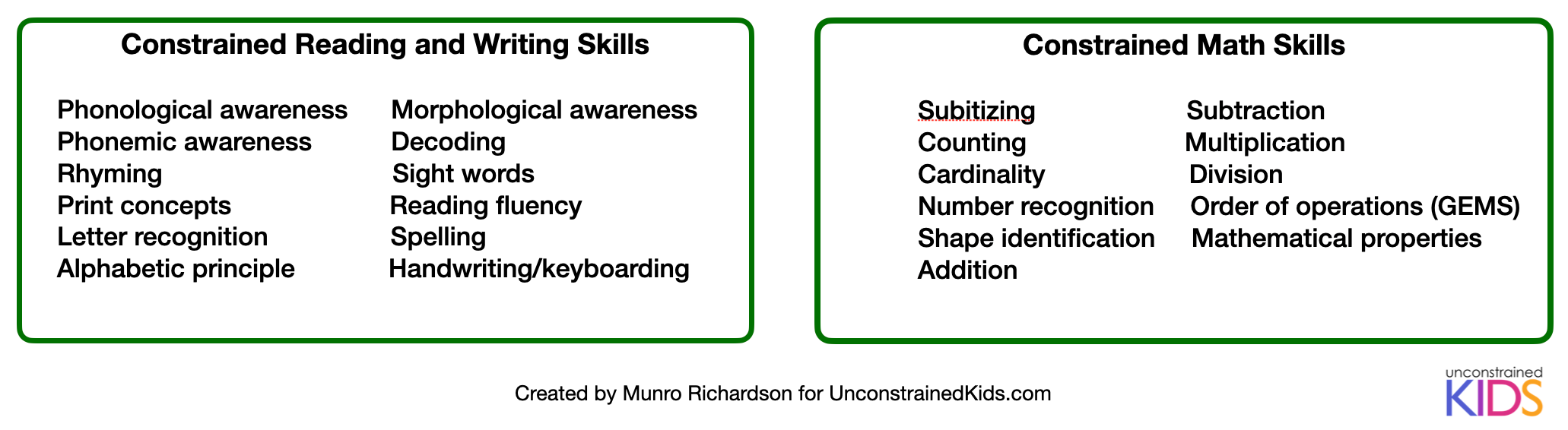
Constrained skills are mostly learned in formal classroom settings. Constrained skills are relatively straightforward to teach. Constrained skills tend to be more visibly. You can actually see whether a child knows their letters, can decode a word, or add 2 +2. In fact, much of the interventions and tutoring children receive to support reading and math focus on constrained skills. Given the limited amount of information involved and universal finish line for mastery, they are also relatively straightforward to assess. Popular reading assessments like DIBELS overwhelmingly focus on constrained skills. Most typically developing children master constrained skills within relatively limited amounts of time.
Unconstrained skills
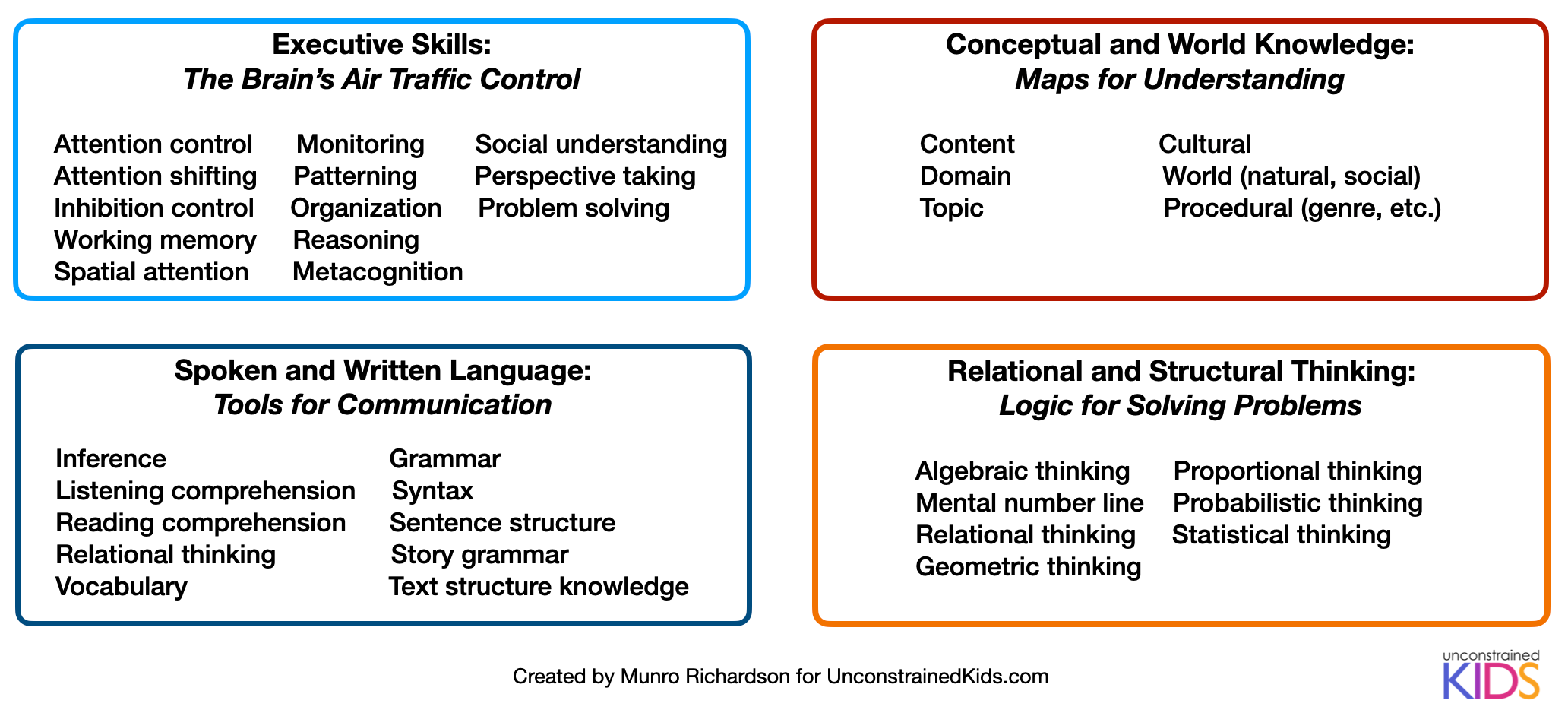
By contrast, unconstrained skills are developed outside and inside formal classroom settings. Given the broader amounts of information involved, it is not as straightforward to teach unconstrained skills. These skills traditionally are harder (but not impossible) to assess.1 For the most part, these unconstrained skills are not assessed as frequently as constrained skills, if at all.2 These “taught and caught” skills generally take more time to build than constrained skills.
Data
The best way to see differences in how constrained and unconstrained skills develop is to track students over time (Paris & Luo, 2010). In this post, I use data from the Early Childhood Longitudinal Study, Kindergarten Class of 1998-99 (ECLS-K). The ECLS-K tracked roughly 22,000 U.S. children from kindergarten (fall 1998) through grade 8 (spring 2007). It’s the best dataset I’ve found to dig deep into individual K-8 reading and math skills. I’ve organized the data by household socioeconomic status.3
In earlier versions of this Substack, I shared (too) many charts of reading and math skills. I’ve narrowed this down to a subset that hopefully provide enough evidence to convince you of the importance of skill type.
Constrained reading skills
Let’s start with constrained reading skills.4 There are roughly 240 ways that we combine the 26 letters in the English alphabet to represent combinations of the 44 basic sounds in the English language. Kids learn the rules for how to read words mainly in school. This first chart shows that despite early differences between students across socioeconomic groups, virtually all children learn basic phonics and decoding rules in elementary school.
Of course, not all words in English follow phonics rules. Kids need to learn to recognize 200-300 irregularly spelled words in order to read proficiently. Again, despite early differences across socioeconomic groups, most kids learn to recognize sight words by third grade. The remaining gap is completely closed by the end of elementary school.
Constrained math skills
In math, children have to master roughly 20 symbols to decode almost any math problem they will encounter in elementary and middle school. Half of these are the ten digits between 0 to 9. The other half are the symbols used in mathematical operations. The standard addition table (from 0 to 9) has 100 facts to learn. The multiplication table (through 12s) has 144 facts (12 x 12) to learn. But when we account for the simple ones for each (like 0s, 1s, and turnarounds like 7 x 3 and 3 x 7) we’re left with about 30 unique addition facts and 36 unique multiplication facts to learn.
This next chart shows proficiency in addition and subtraction from kindergarten through fifth grade. Despite early differences in proficiency by the end of elementary school virtually all kids have reached high proficiency in these constrained math skills.
Proficiency in multiplication and division takes longer.5 There are still meaningful differences across socioeconomic groups at the end of fifth grade. But these gaps largely narrow by the end of middle school.
To sum up, despite early gaps we find that children across socioeconomic groups generally reach a high degree of proficiency in constrained reading and math skills in elementary school. The story looks differently, however, for unconstrained skills.
Unconstrained reading skills
The goal of reading is comprehension: the ability to process written text, understand its meaning, and integrate it with what the reader already knows. Only the first part of that three part definition is constrained — processing written text (i.e. word reading). The other two parts — language comprehension (processing meaning) and conceptual and world knowledge — are unconstrained. When we mix one part constrained skill with two parts unconstrained skill, we get an unconstrained skill: reading comprehension.
This next chart shows proficiency in literal inference (comprehension) from kindergarten through eighth grade.6 As we would expect, few kids in any socioeconomic group are proficient in this reading skill at the end of kindergarten. By the end of first grade, however, a large gap emerges. Although proficiency increases for all students groups across elementary and middle school, the gaps across socioeconomic groups does not significantly narrow like the constrained reading skills.
We see similar patterns for increasingly complex levels of reading comprehension.
Unconstrained math skills
The goal of mathematics is mathematical thinking: the ability to process quantitative situations, understand their underlying structures, and flexibly apply reasoning to make sense of the world. Only the first part of that definition is constrained—processing the quantity (e.g., identifying numbers and basic facts). The other two parts—relational thinking (understanding how numbers relate) and mathematical reasoning (applying logic to new problems)—are unconstrained. When we mix one part constrained procedural skill with two parts unconstrained reasoning, we get an unconstrained skill: mathematical thinking.
This next chart shows proficiency in understanding place value from first through eighth grade.7 This next chart shows proficiency in understanding place value from first through eighth grade. Proficiency here depends upon a child’s “mental number line”—the spatial representation of quantity. This mental number line acts as an “internal map” that allows a child to visualize and locate where a number sits relative to other numbers. It is the core of relational thinking: the ability to see the structure behind the symbols.
Early gaps across socioeconomic groups in this skill appear by first grade. The gaps widen in elementary school and are still meaningfully present by the end of eight grade.
A very common math task in school is solving word problems. Solving a word problem is the “reading comprehension” of mathematics. It requires one part constrained skill (calculation and decoding) and two parts unconstrained skill (relational thinking and linguistic logic). You cannot solve the problem by just “reading” the numbers; you have to understand the “story” of the quantities. This next chart shows proficiency in solving word problems involving rate and measurement from third through eighth grade.8 Significant proficiency gaps are present across socioeconomic groups by third grade that persist through middle school.
Is “unconstrained” an overly complicated way of saying “harder”?
Looking at these charts, it’s reasonable to wonder whether we can simply use the word “harder” or “complex” to describe “unconstrained” skills?9 Indeed, many unconstrained skills are clearly more complex than constrained skills. There is more information to be acquired, consolidated, and integrated to (eventually) use automatically. Proficiency in unconstrained skills often requires mastery of a mix of other constrained and unconstrained skills. In this sense, it is accurate to describe more complex unconstrained skills as “harder” to develop.
But unconstrained skills are distinguished from constrained skills in other ways:
Constrained skills involve information that everyone has virtually equal access to—letters, numbers, high frequency words, numerical operations, etc.
Not everyone has equal access to the information involved with unconstrained skills—vocabulary, comprehension, background knowledge, etc.
Unconstrained skills tend to be “caught and taught,” developing in informal learning environments (e.g. home, community) as well as formal learning environments (e.g. the classroom).
Unconstrained skills such as working memory, cognitive flexibility, vocabulary, and background knowledge develop from learning experiences in and outside of the classroom. Not all kids enjoy the same opportunities for these experiences.
Two distinct developmental pathways
This table offers a summary of the characteristics of constrained and unconstrained skills. It is derived from descriptions of constrained and unconstrained skills in research papers about constrained skill theory. Both skill types follow distinct developmental pathways. Children and youth are likely to have more common opportunities and experiences to develop constrained skills than unconstrained skills.
But wait, there’s more
If you’d like to learn more about constrained and unconstrained skills, check out these other posts:
Works cited
Kim, Y.-S. G., & Pilcher, H. (2016). What is listening comprehension and what does it take to to improve listening comprehension? In R. Schiff & M. Joshi (Eds.), Handbook of Interventions in Learning Disabilities (pp. 159–174). Springer.
McCormick, M., & Mattera, S. (2022). Learning more by measuring more: Building better evidence on pre-k programs by assessing the full range of children’s skills. MDRC.
Paris, S. G., & Luo, S. W. (2010). Confounded statistical analyses hinder interpretation of the NELP report. Educational Researcher, 39(4), 316-322.
Whittingham, C. E., Hoffman, E. B., & Paciga, K. A. (2024). Assessment, accountability, and access: Constrained skill mastery as instructional gatekeeper. Journal of Early Childhood Literacy, 24(1), 69–95.
We’ve seen advances for the assessment of some unconstrained skills, such as executive function. This is an area where AI also holds great promise.
For more on this point, see McCormick and Mattera (2022) and Whittingham et al. (2024).
In the ECLS-K dataset, socioeconomic status is defined using a combination of household income, parental education level, and parental occupation.
Unfortunately, we don’t have any data about children’s writing abilities. Nonetheless, many of these skills also support writing proficiency.
One challenge is distinguishing patterns learned earlier in addition (2 + 3 = 5) to new ones that look similar in multiplication (2 x 3 = 6). Researchers have found that our processing speed to answer the multiplication problem is slower than the addition problem. (Dowker, 2019) This likely is also related to impulse (inhibition) control — our ability to resist the first answer that comes to mind. Impulse control is a core executive function skill, which is an unconstrained skill.
In this assessment, this involves using explicit cues to determine the meaning of written text.
In this case, students were assessed in their proficiency in understanding place value to the hundredths place. Place value to the hundredths is the second digit to the right of the decimal point, representing 1/100 or 0.01 of a whole. It sits to the right of the tenths place and indicates how many hundredths are in a number, such as the ‘5’ in 0.35. Understanding place value is essential for precision, such as money (e.g. 5 cents = 0.05) or percentages (e.g. 7 percent = 0.07).
The assessment evaluates a student’s ability to apply multi-step procedural knowledge to solve complex word problems involving physical units and proportional relationships. This includes tasks such as calculating rates (e.g., speed or price per unit), performing conversions within measurement systems (e.g., length, weight, or time), and using scale to interpret data.
Kim and Pilcher (2016) refer to skills such as vocabulary and listening comprehension as “large problem spaces” that are expansive and continue to grow through our lifetimes. They assert, “[t]his is in contrast to a confined or constrained skill (Paris, 2005) or mastery skill such as acquiring alphabet letters, which has a limited number of units to be learned, and can be taught to mastery in a relatively short time.”